What Happens to Visitor Conversations With Your AI Chatbot (Data Privacy Explained)
Updated August 10, 2026 · 7 min read
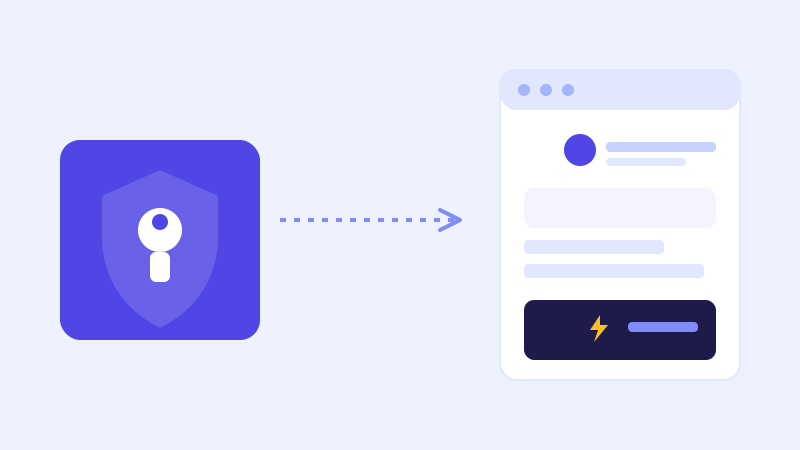
A visitor chatting with a website's AI assistant will often type things they'd think twice about putting in a public review or an email to a stranger: a phone number, an order number, sometimes a health or financial detail relevant to the question they're asking. A chat widget feels private and conversational, which makes visitors less guarded than they'd be filling out a form, and that's exactly why what happens to that data afterward matters more than most businesses installing a chatbot ever ask about.
Two very different kinds of data are involved
It helps to separate two things that get conflated under "the chatbot's data." The first is the knowledge base, the crawled content from the business's own public website, pricing, policies, product pages. That's public information by definition, since it already lived on a page anyone could visit. The second is the conversation log, the actual back-and-forth between a visitor and the bot, which can contain personal information the visitor volunteered mid-chat even if nothing on the site ever asked for it. Those two categories should be handled very differently, and a vendor that treats them the same, or doesn't clearly distinguish them at all, is worth a closer look before you commit.
What actually gets stored when a visitor chats
A conversation log typically includes the visitor's messages, the bot's replies, a timestamp, and often some technical metadata like an approximate location or device type used for basic analytics. If a visitor types an email address, a phone number, or an order number into the chat to get a better answer, that becomes part of the stored conversation too, not because the business asked for it through a form field, but because the visitor volunteered it in the natural course of asking a question. This is the part that catches businesses off guard: a chat log can end up holding more personal information than a contact form ever collected, simply because chat feels lower-stakes to type into.
Where personal information ends up without anyone intending it
Nobody designs a chatbot to collect sensitive information, it happens as a side effect of visitors treating chat like a conversation with a person rather than a structured intake form. A visitor asking about a warranty claim might paste in an order number and a shipping address unprompted. A visitor asking about billing might mention a specific dollar amount tied to their account. None of this is a bot malfunction, it's ordinary conversational behavior, but it means conversation logs deserve the same handling discipline as any other place personal data ends up, even though nothing in the chatbot's design explicitly asked for it.
What data protection rules actually require
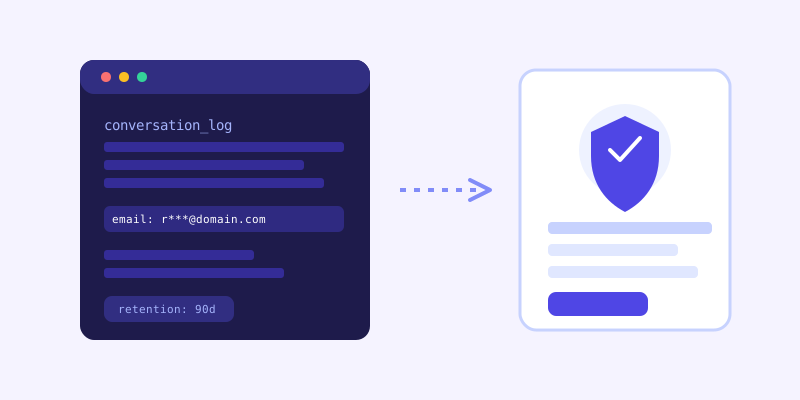
Under frameworks like GDPR, a chatbot vendor processing conversation data on a business's behalf is typically acting as a data processor, with the business itself as the data controller responsible for how that data gets used. In practice, that means a business installing a chatbot should be able to answer basic questions from its own visitors: how long is conversation data kept, can a specific visitor's data be deleted on request, and where is that data actually stored. If a chatbot vendor can't give clear, specific answers to those three questions, that gap becomes the business's liability, not just the vendor's.
Where a live re-check fits into this picture
It's worth being precise about what a live-fallback re-check actually touches, since it's easy to assume anything described as "live" involves more data exposure than it does. When a chatbot's stored knowledge scores too low to confidently answer, and it re-fetches the closest matching page, it's re-reading the business's own already-public webpage, not accessing any visitor's personal information or any private system. The visitor's question that triggered the re-check stays in the conversation log the same as any other message. The live fetch itself is scoped narrowly to refreshing public content, which is a meaningfully smaller footprint than a chatbot that connects into a business's private systems to answer.
Questions worth asking any chatbot vendor
Before trusting a vendor with visitor conversations, ask how long conversation logs are retained by default, and whether that's configurable. Ask whether conversation data is used to train models shared across other customers, or kept isolated to the business's own account. Ask what happens when a visitor or the business requests deletion of a specific conversation. And ask plainly where the data is hosted, since that determines which region's data protection rules actually apply. A vendor with clear, written answers to all four is a meaningfully safer choice than one whose privacy policy only speaks in generalities.
The practical bar to hold a vendor to
None of this requires treating every chatbot conversation as radioactive. It requires the same baseline discipline any business already applies to a contact form or a support inbox: a defined retention period, a way to honor a deletion request, and clarity about where the data lives and who can see it. A chatbot that makes this easy to see and control is doing right by the same visitors who trusted it enough to type something personal into the chat window in the first place.
Frequently asked questions
Does an AI chatbot store everything a visitor types?
Typically yes, in the form of a conversation log that includes the visitor's messages and the bot's replies. If a visitor volunteers personal information like an email or order number while chatting, that becomes part of the stored conversation too, even though nothing explicitly asked for it the way a form field would.
Is a chatbot's knowledge base the same as visitor conversation data?
No, and the distinction matters. The knowledge base is built from a business's own public website content, which is already public by definition. Conversation logs are the actual chat exchanges with visitors, which can contain personal information and should be handled with more care and clearer retention rules than the public website content itself.
Does a live re-check expose any private visitor data?
No. A live-fallback re-check re-fetches a business's own public webpage to refresh the bot's stored knowledge, the same content a search engine could already read. It doesn't touch a visitor's personal information or any private system, and the visitor's question stays in the conversation log the same way any other message does.
What should I ask a chatbot vendor about data privacy before signing up?
Ask how long conversation logs are retained, whether that period is configurable, whether conversation data is used to train models shared across other customers, how a deletion request gets honored, and where the data is actually hosted. Clear, specific answers to all of these are a good sign the vendor takes it seriously.
More articles
 Guides
How to Add an AI Chatbot to Your Website Without Code (2026 Guide)
A step-by-step walkthrough for adding a real AI chatbot to your website in minutes, no flow builder and no code required, plus exact install steps for WordPress, Shopify, Wix, and Squarespace.
Read article → Product & AI
Why Your Website Chatbot Keeps Saying "I'm Not Sure" (And How to Fix It)
Most AI chatbots answer from a snapshot of your site taken whenever they were last trained. Here's why that causes constant "I'm not sure" replies, and what a chatbot that checks live instead actually looks like.
Read article →