AI Chatbots for Accounting and Tax Firms: Answering Deadline, Service, and Document Questions Automatically
Updated October 19, 2026 · 8 min read
Most accounting and tax firms get hit with the same pattern every year: a few quiet months, then a window where the phone rings constantly and the inbox fills with the same handful of questions asked a hundred different ways. When does your firm need everything, what should I bring to my appointment, do you handle my specific entity type, and what does this actually cost. None of those questions require a CPA's judgment to answer. They just require the information to be available the moment a prospective or existing client thinks to ask, which is usually well outside office hours.
What clients are actually asking before they call
The research phase for choosing or working with an accounting firm happens almost entirely on the website, and it's more repetitive than most firms assume. Do you prepare returns for S-corps, or just individuals. Do you handle multi-state filings. What's the deadline to get documents to you if I want my return filed by April 15 and not extended. What should I bring to a first meeting. Do you offer bookkeeping on an ongoing basis or only at tax time. A chatbot trained on the firm's actual site, services pages, FAQ, about page, can answer every one of these the same way a front-desk staff member would, at any hour, without anyone picking up a phone.
Deadlines are the highest-volume question, and the easiest to get wrong
Filing deadlines are where a generic chatbot becomes actively dangerous rather than just unhelpful. A bot that invents a date, or applies the individual deadline to a question about a partnership return, does real damage to a client's trust and potentially their finances. This is exactly the kind of question a crawl-based setup handles well, because it answers only from what the firm has actually published about its own internal cutoffs (the date by which documents need to arrive to guarantee an on-time filing, as opposed to the IRS deadline itself), rather than guessing at tax law from a general training set. If the firm's internal cutoff dates live only in an old newsletter or a staff member's memory, the fix isn't a smarter bot, it's publishing those dates clearly on the site so there's something accurate to answer from.
Document checklists without a round of back-and-forth email
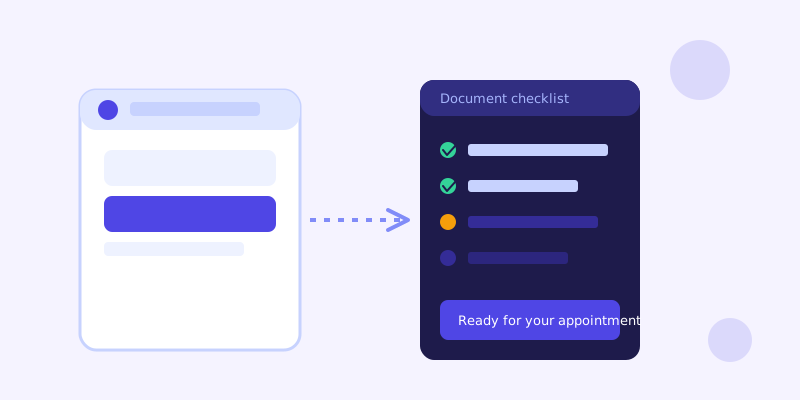
Every firm has some version of an organizer or checklist: W-2s, 1099s, mortgage interest statements, prior year return, business expense summaries, K-1s if applicable. New clients in particular don't know what they don't know, and a round of email where the firm has to ask for missing items after an initial batch wastes time on both sides. A chatbot that can walk someone through "what do I need to bring for a first appointment as a small business owner" versus "what do I need as a W-2 employee with a rental property" turns a checklist that currently lives in a PDF most people skim and forget into an interactive conversation that actually sticks.
Pricing questions, and where the bot should stop
Firms are often cagier about pricing than other service businesses, understandably, since the actual cost depends on complexity that varies client to client. A chatbot shouldn't try to quote an exact number it can't know, but it can and should explain how pricing works in general: whether the firm charges by form, by complexity tier, or a flat fee for simple individual returns, and what tends to push a return into a higher tier (multiple states, rental property, a small business schedule). That's useful, honest information that answers the real question behind "how much does it cost," which is usually "am I going to be surprised by the bill."
Keeping confidential and judgment-based questions out of the chat
A tax chatbot has a clear line it shouldn't cross, and a well-configured one should recognize it rather than attempt an answer. Anything that requires looking at a specific client's actual numbers (their refund status, whether a specific deduction applies to their specific situation, advice on an audit letter they just received) needs a person, not a bot guessing from general site content. The right behavior is a clean handoff: acknowledge the question is outside what it can responsibly answer, and point to a phone number, a secure client portal, or a way to request a callback, rather than producing a confident-sounding answer to a question that depends on information the bot was never given.
Keeping the knowledge base current through busy season
The content that matters most for an accounting firm's chatbot changes on a yearly cycle: updated deadline dates, a new year's standard deduction or mileage rate if the firm publishes those as a convenience, any changes to what services are offered. A site that gets re-crawled on a schedule catches those updates automatically once the page itself is updated, which matters more here than in most industries, since an outdated deadline isn't a minor inconvenience, it's the kind of wrong answer that costs a client an extension fee or a missed filing. The lowest-effort, highest-value habit for a firm running this kind of chatbot is simple: update the actual page the moment a date or policy changes, and let the crawl carry that update into every future conversation.
Frequently asked questions
Can a chatbot tell a client their specific refund status or review their return?
No, and it shouldn't try. Those questions require access to a specific client's actual account and filing data, which a website chatbot doesn't have. A well-configured bot should recognize this kind of question and hand off to a staff member or point to a secure client portal rather than attempting a general answer.
Can the chatbot explain our internal document deadlines correctly for different entity types?
Yes, as long as those deadlines are published clearly on the firm's own site for each entity type (individual, S-corp, partnership, and so on). The chatbot answers from that published content, so the accuracy depends entirely on the firm keeping those specific cutoff dates current and clearly labeled by entity type, not on the bot inferring tax law on its own.
Should a chatbot ever answer general tax law questions?
It's safer to limit it to the firm's own services, process, and published policies rather than open-ended tax law, since tax rules have enough edge cases and client-specific nuance that a confident-sounding wrong answer does more harm than a bot that says it isn't sure and offers to connect the person with a preparer.
How much does this actually help during the January through April rush?
It mainly absorbs the repetitive, high-volume questions (deadlines, what to bring, whether the firm handles a given situation, how pricing generally works) that currently tie up phone lines and staff time during the busiest weeks, freeing that time for the calls that genuinely need a preparer's judgment.
Try it yourself
See how a crawl-based chatbot fits an accounting firm's website on ChatCrawl →
Build my chatbotMore articles
 Guides
How to Add an AI Chatbot to Your Website Without Code (2026 Guide)
A step-by-step walkthrough for adding a real AI chatbot to your website in minutes, no flow builder and no code required, plus exact install steps for WordPress, Shopify, Wix, and Squarespace.
Read article → Product & AI
Why Your Website Chatbot Keeps Saying "I'm Not Sure" (And How to Fix It)
Most AI chatbots answer from a snapshot of your site taken whenever they were last trained. Here's why that causes constant "I'm not sure" replies, and what a chatbot that checks live instead actually looks like.
Read article →