AI Chatbot vs Live Chat Software: What's Actually Different
Updated September 7, 2026 · 6 min read
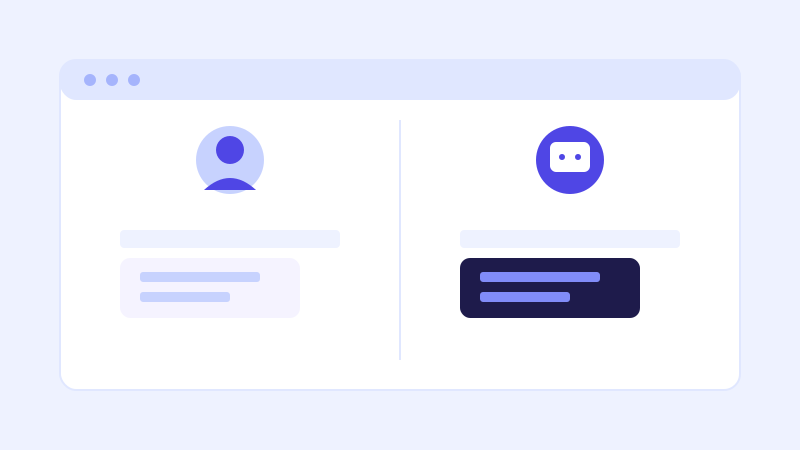
"Live chat" and "AI chatbot" get used almost interchangeably in casual conversation, but they describe two genuinely different tools that happen to look similar: a small window in the corner of a website. What actually answers a visitor's question, a person typing in real time or a model retrieving from your site content, changes almost everything else about how the tool behaves, what it costs, and what it needs from you to work well.
What live chat software actually is
Traditional live chat software connects a website visitor directly to a human, a support agent, a salesperson, sometimes the business owner themselves, typing back in real time. The software's job is routing and infrastructure: queuing incoming chats, notifying whoever's on duty, keeping a transcript, sometimes offering canned responses to speed up typing. The intelligence in the conversation comes entirely from the person on the other end. This is genuinely valuable for judgment calls, an unusual situation, a negotiation, a complaint that needs a human tone. It's also only as good as whoever's watching the queue, which means it only works when someone actually is.
What an AI chatbot actually is
An AI chatbot, at least the kind built by crawling and retrieving from a website's own content, answers without a person typing anything in the moment. It reads a visitor's question, matches it against your site's pricing, policies, and product pages, and generates a reply from what it finds. There's no queue to staff and no shift schedule to maintain, which means it answers identically at 3am on a Sunday as it does at 10am on a Tuesday. The tradeoff is the mirror image of live chat's strength: it's excellent at the repetitive, factual questions your site already answers somewhere, and it's the wrong tool for a judgment call that genuinely needs a person's discretion.
The coverage gap that actually costs businesses money
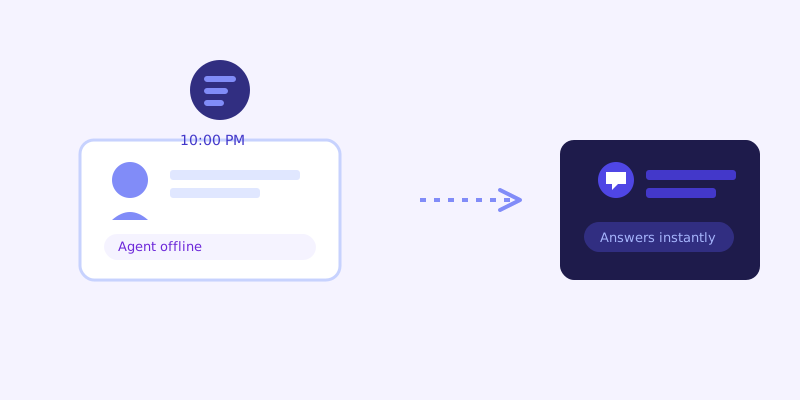
The real-world comparison isn't "which is better," it's what happens during the hours nobody's staffing live chat, which for most small and mid-size businesses is most hours. A visitor asking a pricing question at 9pm gets an instant, accurate answer from a chatbot and gets nothing but an offline message from live chat software, at which point a meaningful share of visitors simply leave rather than wait for a reply the next morning. This is the single biggest practical difference: an AI chatbot's coverage doesn't depend on anyone being logged in, while live chat's usefulness collapses to zero the moment the last agent logs off.
Where live chat still wins outright
A chatbot answering from website content has a hard ceiling: it can only know what's written on your site. A returning customer with an account-specific issue, a genuinely unusual request, or a situation where a visitor is upset and needs to feel heard by an actual person rather than a system, all of those are better served by a human, and pretending otherwise produces exactly the kind of frustrating, circular chatbot experience that gives the category a bad reputation. The strongest setups don't force a choice between the two, they use a chatbot to handle the repetitive, factual majority of questions and hand off cleanly to a person, live if someone's available or async if not, when a conversation genuinely needs one.
Why a crawl-based chatbot needs less upkeep than either alternative
A common middle-ground assumption is that adding AI means adding a maintenance burden, someone has to keep training it, updating its scripts, reviewing its answers. That's true for a chatbot built on a manually written flow or a hand-typed FAQ, but a chatbot built by crawling your website directly inherits whatever's already true on your site, no separate script to maintain in parallel. And when the stored knowledge base scores too low to confidently answer something, the stronger version re-fetches the closest live page before giving up, so an occasional site update doesn't quietly go stale in the bot's memory the way a manually maintained script would.
How to actually decide between them
Start with your real coverage gap: if your business gets meaningful traffic outside the hours you can realistically staff chat, an AI chatbot closes that gap regardless of what else you do. Then look at your question mix, if most inbound chat is repetitive and factual, hours, pricing, policies, availability, a chatbot handles the bulk of it well on its own. If a large share genuinely needs account access or human judgment, live chat, or a chatbot with a clean handoff to a person, matters more than the automated layer alone. Most businesses land on some combination rather than an either-or, and the honest test is simply trying a chatbot on your actual site traffic for a few weeks and watching what ends up in its handoff and unanswered-question logs.
The real question to ask before choosing
The two tools aren't really competing for the same job. Live chat software is infrastructure for a human conversation. An AI chatbot is a way to answer the questions that don't need a human at all, at the hours a human isn't there anyway. The businesses that get the most value tend to stop treating it as a choice between the two and start treating the chatbot as the layer that catches everything live chat was never going to answer in the first place, whether that's 2am on a Tuesday or the ordinary hours-and-pricing question that never needed a person typing back.
Frequently asked questions
Is an AI chatbot the same thing as live chat software?
No. Live chat software connects a visitor to a human typing in real time, while an AI chatbot answers on its own by retrieving from a business's own website content. They look similar as a chat window on a page, but what actually answers the question, and whether that answer exists outside business hours, is completely different.
Can I use both an AI chatbot and live chat software together?
Yes, and it's a common setup. A chatbot handles the repetitive, factual questions on its own, and hands off to a human, live during business hours or asynchronously outside them, when a conversation genuinely needs a person's judgment rather than a stored answer.
Does an AI chatbot require ongoing maintenance the way live chat scripts do?
A chatbot built by crawling a website directly needs much less upkeep than a hand-written script, since it answers from whatever's already on the site rather than a separately maintained set of canned responses. A stronger version also re-checks a live page when its stored answer looks uncertain, which catches recent site changes without any manual update.
Which one should a small business choose first?
Start by looking at when your visitors actually show up versus when you can realistically staff live chat. If there's a meaningful gap, an AI chatbot closes it immediately. Then look at your question mix, mostly repetitive factual questions favor a chatbot, while a large share of account-specific or judgment-based conversations favor keeping a human in the loop, often through a chatbot that hands off cleanly rather than choosing one tool exclusively.
More articles
 Guides
How to Add an AI Chatbot to Your Website Without Code (2026 Guide)
A step-by-step walkthrough for adding a real AI chatbot to your website in minutes, no flow builder and no code required, plus exact install steps for WordPress, Shopify, Wix, and Squarespace.
Read article → Product & AI
Why Your Website Chatbot Keeps Saying "I'm Not Sure" (And How to Fix It)
Most AI chatbots answer from a snapshot of your site taken whenever they were last trained. Here's why that causes constant "I'm not sure" replies, and what a chatbot that checks live instead actually looks like.
Read article →