Does Your AI Chatbot Work in Other Languages? What Multilingual Support Actually Requires
Updated August 6, 2026 · 7 min read
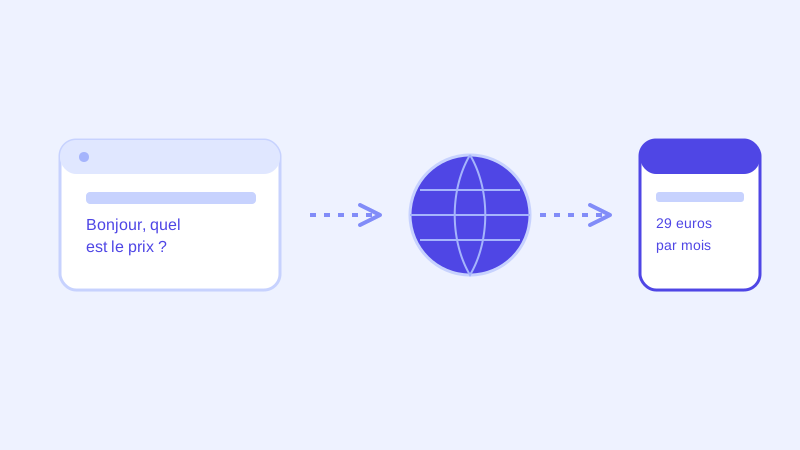
A visitor lands on your site, opens the chat widget, and types a question in a language your website was never written in. What happens next depends entirely on how the chatbot was built, and the difference between a bot that genuinely handles this and one that just breaks quietly is easy to miss until an actual international visitor tries it.
The two different things people mean by "multilingual"
"Multilingual chatbot" gets used to describe two different capabilities that often get bundled together in marketing but aren't the same thing. The first is a translated widget: greeting text, button labels, and interface chrome shown in the visitor's language. The second is the bot actually understanding a question asked in one language and answering correctly using knowledge that may only exist on your site in a different language. The first is a straightforward localization task. The second is the part that actually determines whether an international visitor gets a useful answer.
How this actually works under the hood
Modern embeddings, the numeric representations used to match a question to relevant content, are largely language-agnostic in practice. A question asked in Spanish can match against a chunk of English website content if the underlying model was trained on enough multilingual data, because the embedding captures meaning rather than exact words or a specific language. This is genuinely useful: it means a chatbot can often retrieve the right passage from your site even when the visitor's question and your source content are in different languages. What it doesn't automatically do is guarantee the final answer, the actual sentence generated back to the visitor, comes out fluent and natural in their language rather than an awkward literal rendering.
The website content problem: you can only translate what got crawled
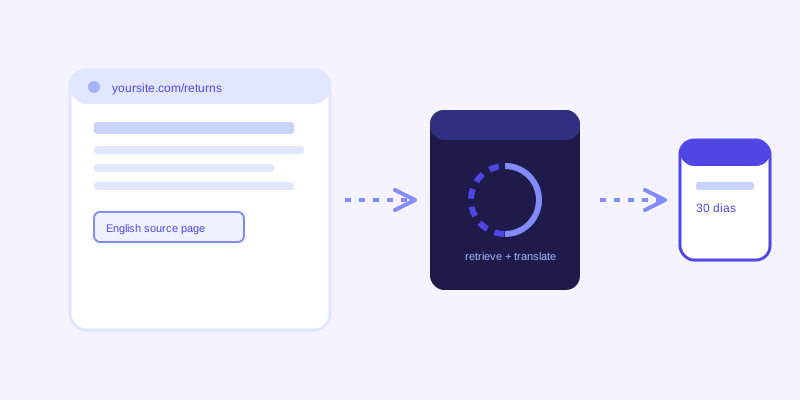
A chatbot's knowledge is only as complete as what the crawl found, and if your site exists only in English, that's the only language of source material the bot has to work with, regardless of what language a visitor asks in. A well-built bot can retrieve the right English passage for a French question and translate the answer on the way out, but it's translating on the fly from a single source of truth, not reading a French version of your policy that was written and reviewed separately. For most factual content (pricing, hours, policies) that's a reasonable tradeoff. For anything where exact wording carries legal weight, a contract term, a regulated disclosure, translating on the fly is riskier than having an actual reviewed translation on the site itself.
Where live-fallback matters even more for multilingual visitors
International visitors are disproportionately likely to hit gaps in a chatbot's stored knowledge, simply because they're often asking about region-specific details, shipping to their country, a local phone number, a region's return process, that may be thinner on the site than the core content. When the stored knowledge base scores too low to confidently answer a question like this, the same live re-check that helps any visitor helps here specifically: the bot goes back to the closest matching page, reads it fresh, and answers from what it just found rather than guessing or defaulting to a generic response that ignores the visitor's actual region.
Where multilingual support commonly breaks in practice
A few failure patterns show up repeatedly even in chatbots that advertise multilingual support. Product or technical terminology gets mistranslated because the model has no domain-specific glossary for your business, so a feature name that should stay untranslated gets awkwardly rendered instead. Numbers, currencies, and units don't get localized even when the surrounding sentence is translated correctly, so a price shows in the source currency with no conversion or note. And confidence scoring, the mechanism that should trigger a live re-check or an honest "I don't know," can behave less reliably across languages if it wasn't tested outside the site's primary language, meaning a bot might hedge unnecessarily in one language while answering too confidently in another.
A simple test before you trust the claim
Ask the chatbot a question in a language your site isn't written in, ideally something specific and checkable, like your return window or a shipping detail for a particular country. Check whether the answer is both fluent and factually correct, not just fluent. Then ask something you know isn't covered anywhere on your site, in that same language, and confirm the bot says so honestly rather than inventing an answer, since a chatbot's tendency to hallucinate doesn't disappear just because the question came in a different language, it can get worse if the model is working harder to produce a fluent-sounding reply.
What to actually ask a chatbot vendor
Beyond "does it support multiple languages," ask what the bot does when a question comes in a language different from your site's source content: does it retrieve across languages and translate the answer, or does it need a separately maintained knowledge base per language. Ask whether confidence scoring and the live re-check behavior are language-independent or were only tuned against the primary language. And if you serve regions with genuinely different policies, not just a different language, confirm the bot can tell those apart rather than answering every region with the same generic policy translated into a different tongue.
Frequently asked questions
Can an AI chatbot answer questions in a language different from my website's content?
Often yes, because modern embeddings match meaning across languages rather than exact words, letting a chatbot retrieve the right passage from an English page even when a visitor asks in French or Spanish. The bot then translates the answer on the way out, which works well for most factual content but isn't the same as having a separately reviewed translation of your site.
Is a translated chat widget the same as a multilingual chatbot?
No. A translated widget only localizes the interface text, like button labels and the greeting message. Whether the bot actually understands a question and answers correctly in another language depends on its retrieval and generation pipeline, not on whether the surrounding buttons are translated.
Why might a chatbot hedge more often when asked questions in another language?
If confidence scoring was only tested against a site's primary language, it can behave less predictably in other languages, either hedging too often or, more concerning, answering too confidently on something it shouldn't. It's worth testing a chatbot's behavior directly in each language your visitors actually use rather than assuming multilingual support was validated evenly across all of them.
Should I write my website content in multiple languages if I use a multilingual chatbot?
For anything where exact wording matters, like legal terms or regulated disclosures, yes, a reviewed translation on the site itself is safer than relying on a chatbot to translate on the fly every time. For general factual content like hours or product descriptions, cross-language retrieval and translation is usually a reasonable way to serve visitors without maintaining a fully separate version of the site per language.
More articles
 Guides
How to Add an AI Chatbot to Your Website Without Code (2026 Guide)
A step-by-step walkthrough for adding a real AI chatbot to your website in minutes, no flow builder and no code required, plus exact install steps for WordPress, Shopify, Wix, and Squarespace.
Read article → Product & AI
Why Your Website Chatbot Keeps Saying "I'm Not Sure" (And How to Fix It)
Most AI chatbots answer from a snapshot of your site taken whenever they were last trained. Here's why that causes constant "I'm not sure" replies, and what a chatbot that checks live instead actually looks like.
Read article →